Hip & Lower-Back Mobility: 3 Simple Exercises to Help You Move Better
Do your hips feel stiff after sitting for long periods? Do you sometimes notice your lower back feels tight when you get up from your desk, get out of the car or start moving after a busy day?
You're not alone.
Many of us spend a large part of the day sitting, whether that's at a desk, driving, working from home or simply juggling everyday responsibilities. Although sitting itself isn't necessarily a problem, spending long periods in one position means we often have fewer opportunities to move our joints through different ranges of movement.
That's why making time for mobility can be a useful part of a balanced fitness routine.
As part of my Hip Strength & Mobility exercise series, I'm sharing three simple exercises to help you introduce more movement through your hips and lower back.
You don't need a gym membership, expensive equipment or a lengthy routine. These exercises can be performed at home and adapted to suit your current ability.
Let's take a closer look.
1. Supine Knee Rolls
A gentle introduction to movement through your hips and lower trunk.
Supine knee rolls are a simple mobility exercise that introduces gentle rotation through your lower trunk and hips.
It's a useful movement to include in a warm-up or as part of a short mobility routine, particularly if you've spent a long time sitting.
How to perform the exercise:
Lie on your back with your knees bent and your feet flat on the floor.
Keep your shoulders relaxed and resting comfortably against the floor.
Slowly allow both knees to move towards one side.
Return to the centre and repeat towards the opposite side.
Continue alternating sides with a slow, controlled movement.
What does it work?
This movement involves gentle rotation through the lower trunk and hips, with your abdominal and trunk muscles helping to control the movement.
It also gives you an opportunity to explore comfortable rotational movement without needing to support your body weight.
My coaching tips:
Keep your shoulders relaxed.
Move slowly rather than dropping your knees from side to side.
Don't force your knees towards the floor.
Work within a comfortable range.
How much? Try 8–10 repetitions in total, alternating sides.
Supine Knee Rolls demonstration video
2. Half-Kneeling Hip Flexor Stretch
Give the front of your hips a little attention.
The hip flexors are a group of muscles at the front of your hips that help lift your knees and bring your thighs towards your torso.
They also contribute to hip flexion and extension.
If you spend a lot of time sitting, introducing movements that take your hips into extension can be a useful addition to your mobility routine.
The half-kneeling hip flexor stretch is a simple way to do this.
How to perform the exercise:
Start in a half-kneeling position, with one knee on the floor and the opposite foot positioned in front.
Gently tuck your pelvis, as though bringing your belt buckle slightly towards your ribs.
Engage the glute on the side of your kneeling leg.
Slowly shift your body forwards a small amount.
You should feel a gentle stretch towards the front of the hip on your kneeling side.
Hold the position before changing sides.
What does it work?
This stretch targets the hip flexor muscles, including the iliopsoas and potentially the rectus femoris, depending on your position.
It introduces a controlled hip extension position and can help you become more comfortable exploring that range of movement.
My coaching tips:
Keep your pelvis gently tucked.
Avoid arching your lower back to make the stretch feel deeper.
Keep your movement small and controlled.
You should feel a gentle stretch, not pain or pinching.
How much? Hold for 20–30 seconds on each side.
Half-Kneeling Hip Flexor Stretch
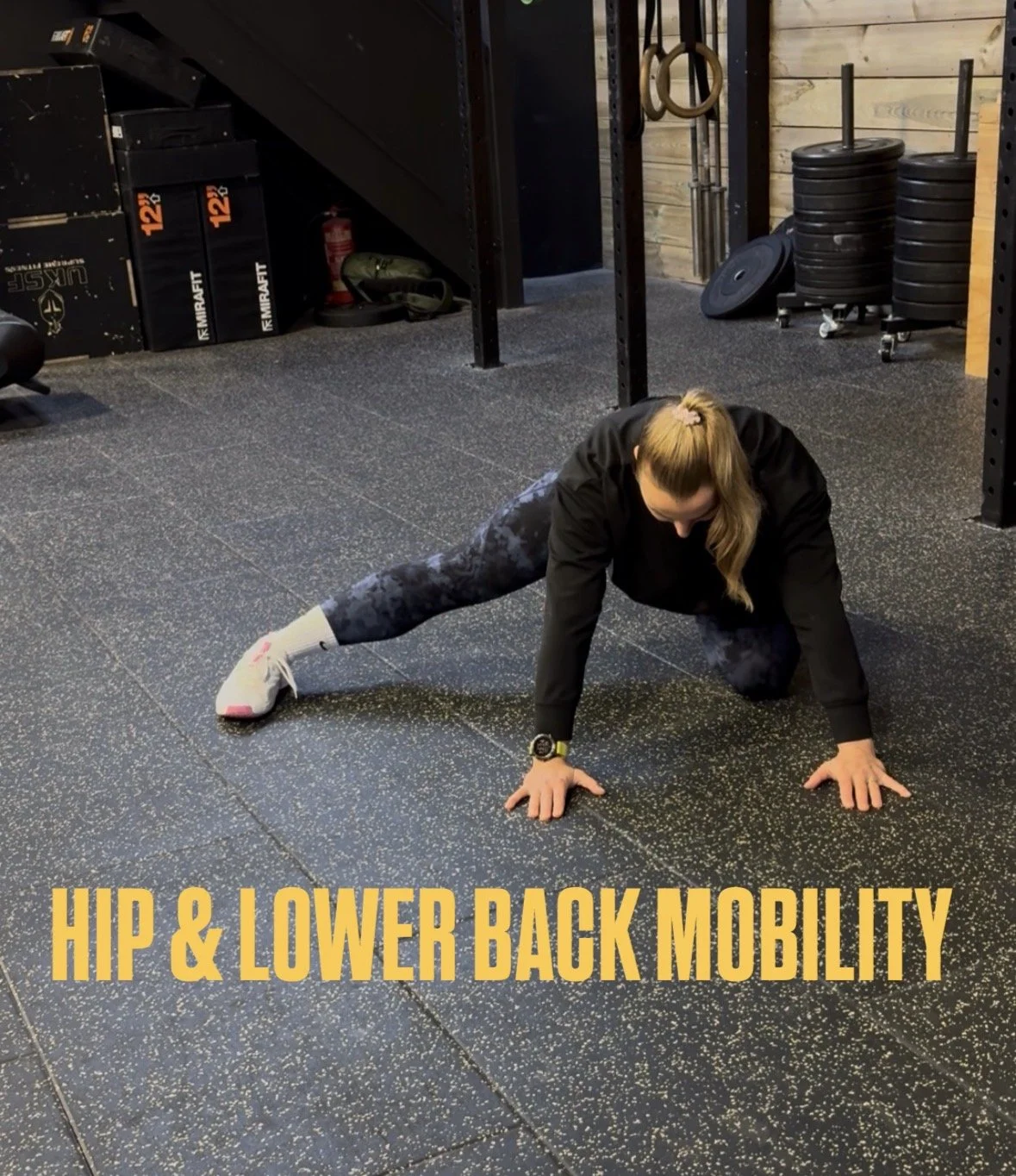
3. Adductor Rock-Backs
Don't forget your inner thighs when working on hip mobility.
When we think about hip mobility, we often focus on the front and back of the hips. However, the muscles on the inside of your thighs also play an important role in hip movement.
These muscles are known as the hip adductors.
They help bring your legs towards the midline of your body and contribute to controlling movement during activities such as walking, running, squatting and changing direction.
Adductor rock-backs are a simple way to explore hip movement while introducing a gentle stretch through the inner thigh.
How to perform the exercise:
Start on all fours, with your hands underneath your shoulders and knees underneath your hips.
Extend one leg out to the side, keeping your foot flat on the floor.
Keep your back in a comfortable neutral position.
Slowly push your hips backwards towards your heels.
Return to your starting position.
Repeat before changing sides.
What does it work?
The movement introduces hip flexion while lengthening the adductors of the extended leg.
It also encourages controlled movement through the hips and helps you explore your available range of motion.
My coaching tips:
Keep your extended foot flat on the floor.
Move backwards slowly and smoothly.
Avoid rounding your lower back to gain extra range.
Don't force the stretch. Work within a comfortable range.
How much? Try 8–10 repetitions on each side.
Adductor Rock-Backs
Mobility Is Only One Part of the Picture
Mobility is important, but it shouldn't be the only focus of your training.
Your hips and lower back work alongside the rest of your body during everyday activities and exercise. Building strength, improving balance and developing good movement control are also important parts of maintaining physical capability.
That's why this series will move beyond mobility to explore glute strength, hip stability, squats, lunges, hip hinges and single-leg exercises.
The aim is to build a well-rounded approach to movement and strength that you can carry into everyday life and your fitness training.
A final reminder: If an exercise causes pain, stop or adjust the movement. These are general mobility exercises, not a treatment for an underlying injury or persistent pain. If you have ongoing symptoms or concerns, seek advice from an appropriate healthcare professional.
Want to Move Better and Build Strength?
At Petra Woolmer Coaching, I help people develop strength, improve fitness and build healthier movement habits through personal training and coaching.
I offer one-to-one personal training in and around Ingatestone, Essex, as well as online coaching.
You don't need to be fit or strong before you start. You just need a place to begin.
Get in touch for an informal chat about how we can work towards your fitness goals.